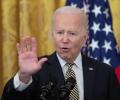
Biden, while not ruling out the meeting Putin at G20 meet, said that there are conditions attached.

India's tactical and operational response demonstrated its ability to prosecute tri-service operations, even without a formal tri-service doctrine or the higher command structure needed to coordinate it, points out Ajai Shukla.

Adrian Levy , co-author of the recently-published Deception- Pakistan, the United States and the Global Nuclear Weapons Conspiracy, told rediff.com in an exclusive interview that an honest investigation into the assassination of former Pakistan Prime Minister Benazir Bhutto may reveal the hand of the country's military behind it.

'Obama's visit to Hiroshima must generate a fresh debate in the international community about how to reduce the salience of nuclear weapons in international politics and how to disarm the world from these monstrous weapons forever,' says Sanjeev Shrivastav..
A new computer modeling study has suggested that a limited nuclear weapons exchange between India and Pakistan using their current arsenals could create a near-global ozone hole, triggering human health problems and wreaking environmental havoc for at least a decade. The study was led by University of Colorado at Boulder scientists Brian Toon and Michael Mills.
India and Pakistan have a real opportunity to take relations forward after the exit of President Pervez Musharraf, feels Adrian Levy, co-author of Deception: Pakistan, the United States and the Global Nuclear Weapons Conspiracy.

To imagine that no one contributed to global peace to deserve the prize in 2017 is to be extremely cynical about peacemakers around the globe.

By threatening to punish India with high tariff, Trump is actually planting a tantalising thought in the Indian mind that the Modi government should suitably 'incentivise' him, explains Ambassador M K Bhadrakumar.
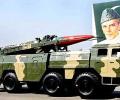
Pakistan military has appointed Lt Gen Zubair Mahmood Hayat as the new chief of the Strategic Plans Division, which manages and secures the country's nuclear arsenal.

A must read for a generation that grew up on his novels.
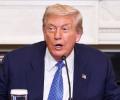
If the US' renewed closeness with Pakistan ends up strengthening Pakistan's military, it will clearly show that Washington no longer wants a strong India and could be ready to let China dominate Asia, notes Colonel Anil A Athale (retd).
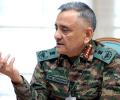
Chief of Defence Staff General Anil Chauhan on Saturday said India's Operation Sindoor has drawn a 'new red line' of intolerance against terror, and expressed hope that the military action has brought 'some lessons for our adversary also'.

During last week's Nuclear Security Summit, President Obama asked the media to leave and then screened videos depicting plausible scenarios pertaining to nuclear terrorism.
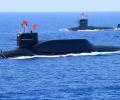
China has delivered a second advanced submarine to Pakistan, part of a larger deal to bolster the South Asian nation's naval capabilities in the Indian Ocean. The move underscores China's growing influence in the region and its strategic partnership with Pakistan.
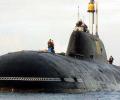
China on Tuesday angrily denounced the nuclear-powered submarine deal announced by the US, UK and Australia, saying the pact violates the Non-Proliferation Treaty (NPT) and the three countries are travelling "further down the dangerous and wrong path."
'Unfortunately, India and Pakistan could learn a 'lesson' from this conflict that will make them more likely to use these weapons against each other in the future.' 'Rounds of missile and drone attacks could be more routine features of their hostility, just like artillery fire has become a familiar fact of life along the Line of Control.'

Proliferation and potential use of nuclear weapons pose the most dangerous threat to global security and peace, US President Barack Obama has said.
Even as Pakistan continues to urge the international community to accept its membership to the Nuclear Suppliers Group, highly placed sources in the United States who are involved with the tracking of nuclear commerce have claimed that Islamabad is still selling nuclear materials to North Korea.

Vajpayee had always felt that India must act with conviction and panache. He decided that, irrespective of the attendant risks, he would undertake what many felt was a precarious course. A fascinating excerpt from N K Singh's Portraits Of Power: Half A Century Of Being At Ringside on Atalji's 96th birthday, December 25.

Ahead of his much-anticipated visit to conflict-torn Ukraine, Prime Minister Narendra Modi on Thursday said India firmly believes that no problem can be solved on the battlefield and it is ready to extend all possible cooperation for the restoration of peace and stability in the region.
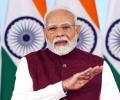
Presenting the full text of Prime Minister Narendra Modi's address to the nation on May 12, 2025, in which he dictated India's new doctrines on countering terrorism.
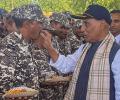
India on Friday called on the International Monetary Fund (IMF) to reconsider its $1 billion assistance to Pakistan, suggesting that Islamabad could use it for terror funding.

"The recent election in Pakistan, as well as the normalising of US-Pakistan relations, are necessary but not sufficient conditions for the regularising of India-Pakistan relations," noted American scholar Stephen P Cohen has said.

'With two nuclear neighbours, how likely is it for our armed forces to battle in a contaminated environment that could include nuclear, biological or chemical attacks by the adversary?' 'Are we prepared for the threat?' Brigadier S K Chatterji (retd) explains the meaning and significance of Operation Vijay Prahar.

India has maintained communication with both Russia and Ukraine. It is time Narendra Modi steps up on the world stage and plays the role of peacemaker, suggests military historian Colonel Anil A Athale (retd).

Would Ukraine be such a pushover if it had that nuclear stockpile?' asks Shekhar Gupta.

20 years ago this day, May 11, 1998, India conducted its second nuclear test at Pokharan in Rajasthan. In a fascinating interview on Rediff.com, K Subrahmanyam revealed how Indian PMs reacted to nuclear ambitions.

It's time India re-visited its Western alliances for the attitude and approach that the West reserves for the nation when it comes to security cooperation of the kind that they might not have visualised outside of China, India's bug-bear, asserts N Sathiya Moorthy.

'It's a threat to whoever you want, and it includes China, and it includes Russia and it includes anybody else that wants to play that game. You can't do that. You can't play that game on me'

United Nations chief Ban Ki-moon has appealed to India, China and the US along with five other nations to ratify the Comprehensive Nuclear Test-Ban Treaty, saying the international community should complete the "unfinished business" of achieving a world free of atomic weapons.

United States President Barack Obama has hailed the "historic understanding" reached between world powers and Iran over the framework of a deal on its contentious nuclear programme, even as Israel warned that it would threaten the Jewish state's survival.

'Pakistan will try to escalate covert operations through terrorism,' says Dr Shalini Chawla.
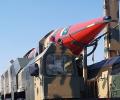
Pakistan will not delegate "advance authority" over nuclear weapons to military unit commanders even in the event of a crisis with India, according to a media report.

If you are serious about countering the Chinese threat, then the best weapon is investing in real freedom, plurality, elections and democracy. Unfortunately, it isn't an approach all Indians currently seem to agree on, asserts Shyam G Menon.

The 193-member General Assembly adopted the draft resolution, put forward by Ukraine and its supporters, titled 'Principles of the Charter of the United Nations underlying a comprehensive, just and lasting peace in Ukraine'.

Chinese foreign ministry spokesperson, Hua Chunying said China-Pakistan cooperation is in accordance with the 48-member nuclear club, which supervises global nuclear commerce.
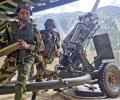
'Will this near-war, India's strongest military response so far, buy India another seven years of deterrence?' asks Shekhar Gupta.

The Hague Code of Conduct against Ballistic Missile Proliferation is a toothless mechanism, but it may well end up serving India's interests, says Ajay Lele.

He said that the US 'does not, and never will, accept North Korea as a nuclear state'.
